
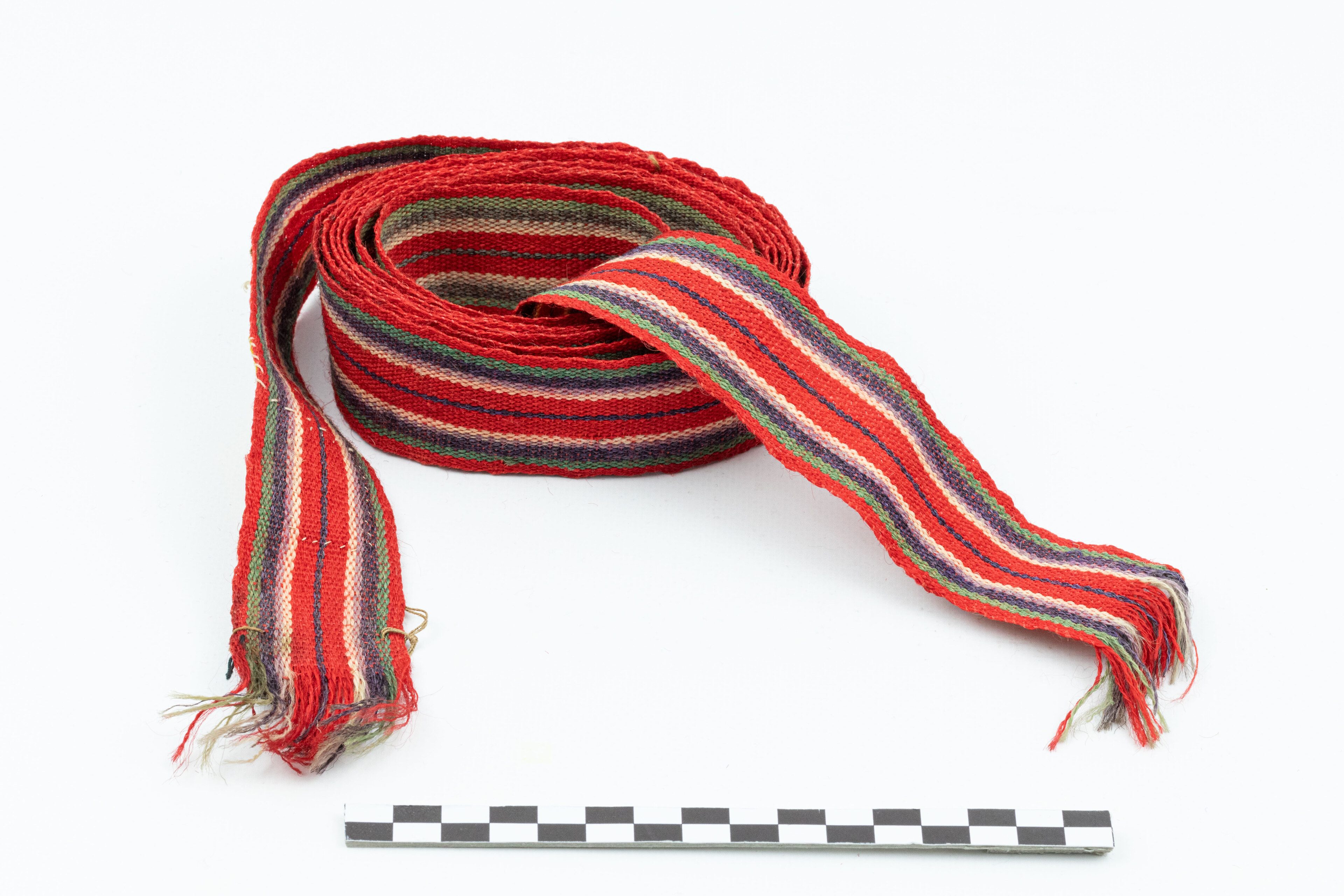
Kraika Belt
The belt is made in the form of a narrow woven band decorated with a striped pattern in red, green, blue, lilac, and white. The ends are finished with tassels.
The Ukrainian name kraika derives from the word krai, meaning “edge”, and is associated with the method of making a narrow woven band with clearly defined edges. Kraiky were widespread throughout Ukraine and were used as part of both everyday and festive clothing. They served to secure unsewn or sewn garments, such as plakhtas, zapaskas, and trousers, and to fasten outer garments, including svytky.
At the same time, the belt had an important symbolic meaning. In traditional beliefs, it functioned as a protective amulet, shielding a person from evil forces and symbolising vitality, prosperity, and order. For this reason, belts were widely used in wedding, childbirth, and calendar rituals. Kraiky held a particularly important place in wedding ceremonies. The bride would give belts woven by her own hands to the groom, matchmakers, groomsmen, and other participants in the wedding. Such items were often distinguished by more elaborate ornamentation and brighter colours.
Today, kraiky are important examples of Ukrainian folk weaving. They are preserved in museum collections as examples of traditional decorative and applied art and as evidence of the high level of skill of folk weavers. At the same time, the tradition of making kraiky is being revived by contemporary craftspeople and ethnocultural centres in Ukraine.
Provenance: From the museum collection, acquired before the Second World War.
Passport of exhibit
- Inventory marks: ПКМВК 7397 Тк 2524
- Author (manufacturer): Unknown master
- Material: Wool
- Technique: Weaving
- Dating: 19th Century
- Size: 233 х 4 сm