
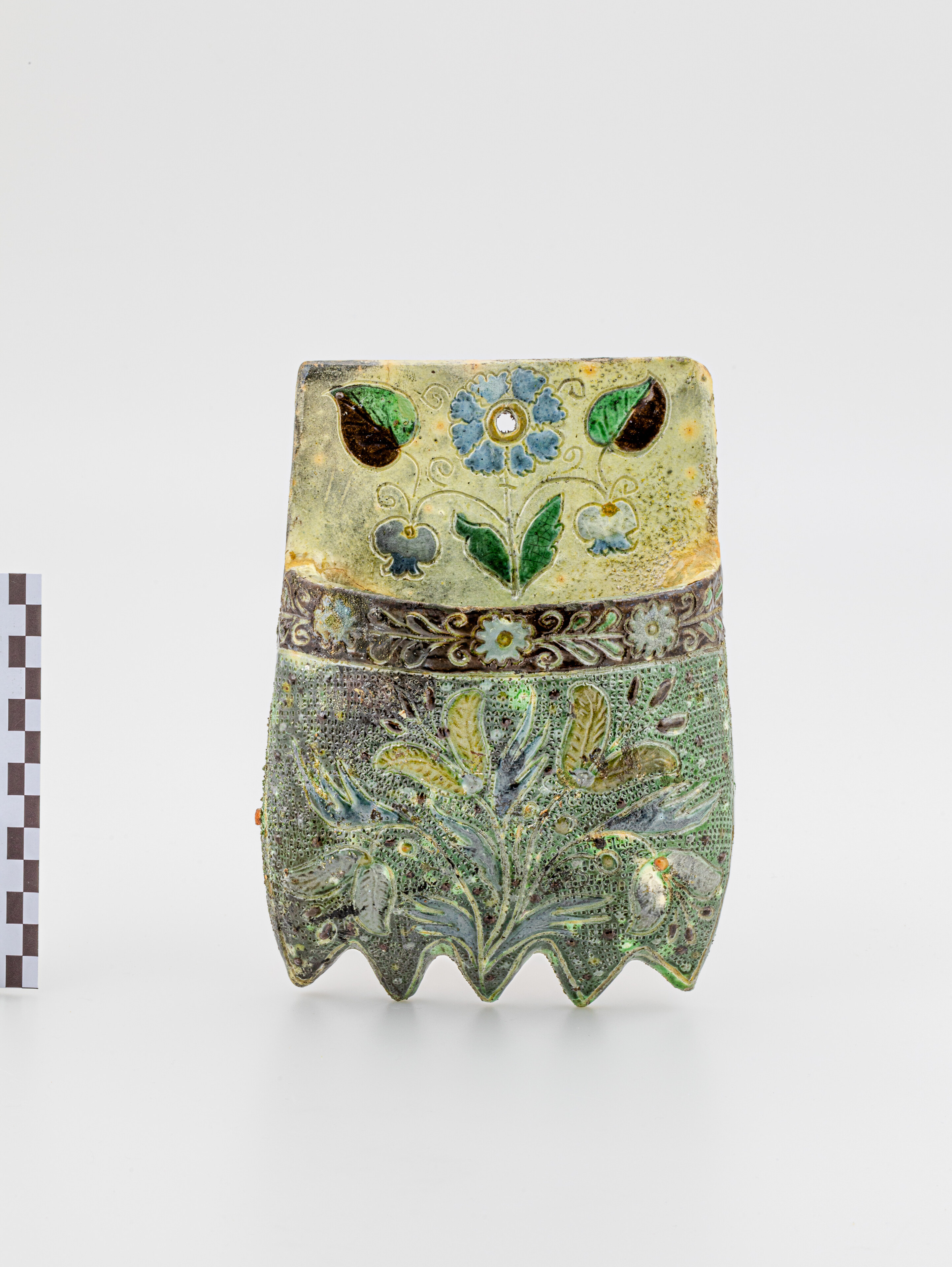
Wall Decoration in the Form of a Pocket
Poltava Region, Opishnia. Made by Omelko Ivanovych Kolpak.
The background of the wall-mounted section is light yellow, while the pocket itself is dark green. The surface is decorated with a floral ornament in the Art Nouveau style, featuring stylised tulip, pomegranate, and flax flowers, as well as leaves. The composition is dynamic and expressive. The upper part is covered with light cream glaze. At the centre is a stylised flower with blue petals and a round yellowish centre. Thin green stems with symmetrically arranged leaves and small flowers radiate from it. On either side, the composition is completed by large leaves painted in green and dark brown.
A narrow horizontal band with raised vegetal ornament runs along the lower edge of the pocket. It features small flowers and scrolls accentuated with dark brown, green, and light glazes.
The main part of the pocket is occupied by a relief representation of a large flowering plant. Lush stems with elongated leaves and pomegranate flowers rise from the base. The ornament is rendered in green, grey-blue, yellowish, and brown tones, which blend softly with one another. The surface of the pocket is covered with incised dots. The reverse is terracotta and unglazed, bearing the maker’s mark “Опішня / О. І. Колпак” (“Opishnia / O. I. Kolpak”).
Omelko Ivanovych Kolpak was born in 1888 in Opishnia into a family of potters. Dynastic continuity was characteristic of all branches of the pottery industry and played an important role in preserving and enriching the professional knowledge of folk craftsmen. Kolpak inherited his interest in the craft from his father, who produced bricks, pottery, and toys and sold them at the local market. After completing four years at a parish school, the young potter began working in the 1910s in a potters’ cooperative at the Opishnia Pottery Training and Demonstration Centre. He later left his native region for a short period during the First World War, but subsequently returned and resumed his craft.
From 1929 to 1950, with interruptions, Kolpak worked in the “Chervonyi Kustar” and “Khudozhnii Keramik” cooperatives. In 1933–1934, he lived in Batumi in the Caucasus, and in 1948 in Sencha, Poltava Region, where he organised the “Keramik” pottery cooperative. From 1950, Omelko Kolpak lived in Poltava, where he remained until his death in 1972.
His works were repeatedly exhibited at local and all-Union exhibitions, although he did not achieve widespread fame. The early period of his artistic career was strongly influenced by the Art Nouveau style. Works from this period are distinguished by a high level of craftsmanship and an innovative approach to the forms and decoration of ceramic objects. They were in demand, received recognition, and were even exported. Later, under the pressure of changing circumstances and ideological demands, the artist turned to the mass aesthetic of the post-war period, which better met contemporary demand and helped him avoid persecution.
Provenance: From the museum collection, acquired before the Second World War.
Passport of exhibit
- Inventory marks: ПКМВК 12716 Кс 1141
- Author (manufacturer): Kolpak Omelko Ivanovych
- Material: Clay, Engobes, Glaze
- Technique: Painting, Modeling, Glazing, baking, Incising
- Dating: 1910s–1930s.
- Size: 20 х 14,3 х 5 сm