
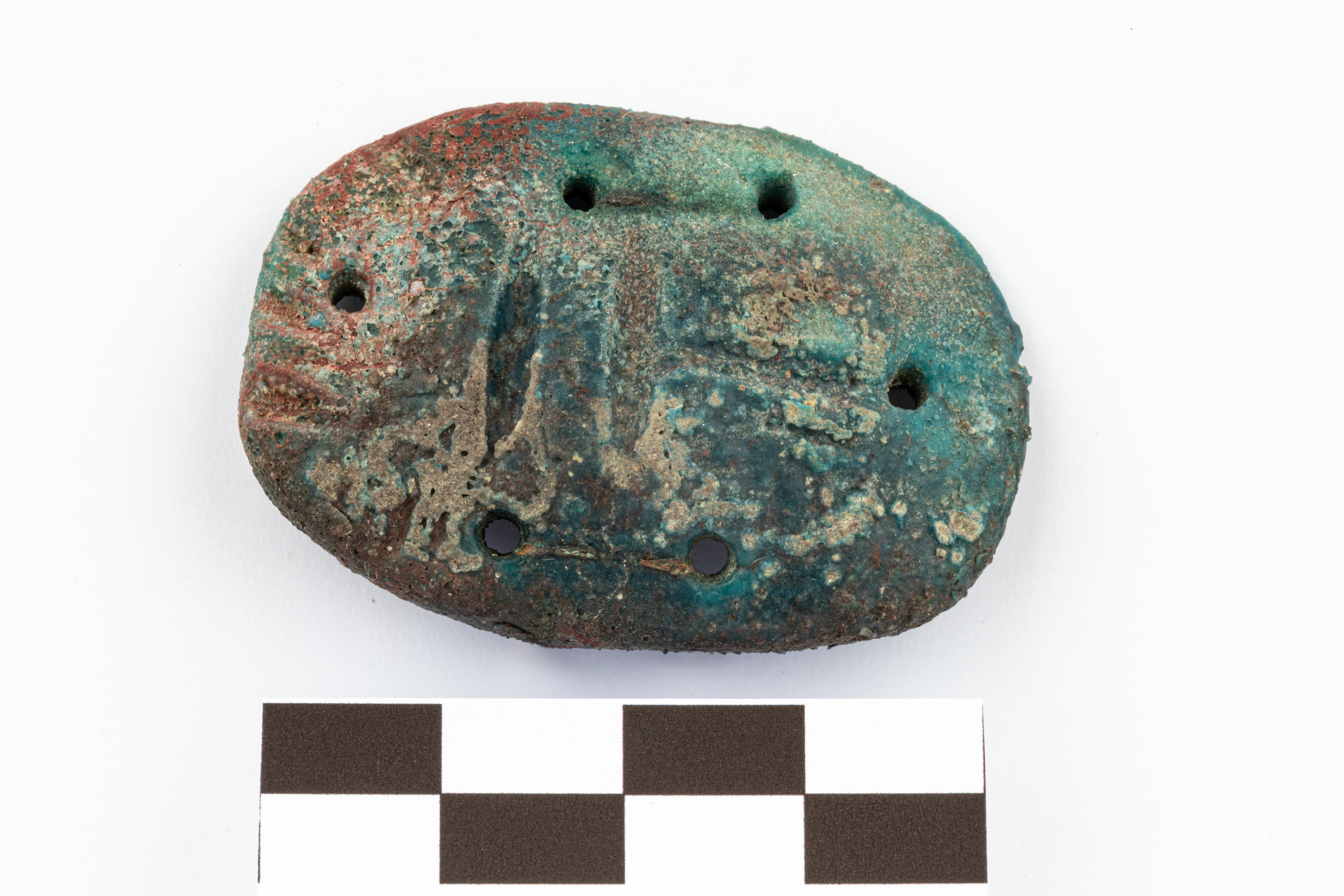
Scarab
Ancient Egypt, Thebes, necropolis.
A miniature amuletic sculpture in the form of a scarab beetle, made of faience and covered with blue glaze characteristic of Ancient Egyptian objects. The upper part reproduces the anatomical features of the insect, including the head and wing cases. The flat underside bears a carved inscription. Six perforations are arranged around the perimeter.
In Ancient Egyptian culture, the scarab was one of the most widespread amulets and symbolized rebirth, vitality, and the daily renewal of the sun. Its image was associated with the god Khepri, the morning manifestation of the solar deity who was believed to be reborn in the sky each morning. Objects of this type were used as personal amulets, seals, temple offerings, or funerary equipment.
The manufacturing process involved shaping the object from a quartz-based paste, followed by firing and the application of coloured glaze. Owing to their vivid colouring and symbolic significance, faience scarabs became widespread in Egypt from the Middle Kingdom through the later periods of Egyptian history.
Provenance: The object was donated to the museum by P. P. Bobrovskyi in 1903.
Passport of exhibit
- Inventory marks: ПКМВК 149 А 149/63
- Author (manufacturer): Unknown master
- Material: Faience
- Technique: Forming
- Dating: 1st millennium BCE
- Size: 4,5 х 3,2 х 1 сm